This year we held the fifth edition of Ventilation Symposium. The event took place in Oslo, Norway, over two days in beautiful surroundings: the 12th floor at the MUNCH museum with views over the city center. It provided the perfect scene for gathering Nordic healthcare professionals working with mechanical ventilation to learn, get inspired, and exchange knowledge.

The MUNCH museum
Ventilation Symposium 5.0 was organized in collaboration with our partners Hamilton Medical and Timpel Medical. The overall theme was “individualized ventilation”. On day 1 pediatric and neonatal ventilation was at the center and talks were held in Scandinavian languages. Day 2 focused on mechanical ventilation treatment of adult patients and talks were held in English. We were privileged to have an exceptional lineup of speakers, both local and international, who shared their invaluable insights into individualized strategies for lung-protective ventilation. This article presents the key messages from the talks, highlighting the innovative approaches and expert opinions that can revolutionize respiratory care.
Respiratory failure in children
Jo Eidet, Head Doctor, PhD., Consultant at the pediatric anesthesiology team at Oslo University Hospital, Rikshospitalet, kicked off Ventilation Symposium 5.0. He gave the audience a thorough introduction to the topic “respiratory failure in children”.
Jo started with an overview of the causes of respiratory failure, and how the child’s lung function differs from the adult. Then he shared expert opinions on guidelines for therapeutic measures, which were placed on the spectrum HFNC –> NIV –> CMV –> HFOV –> ECMO. But how do you select treatment option and know when to escalate the treatment? Here Jo emphasized that you need some rules of thumb: You need something to guide you, otherwise you might wait too long before changing strategy. Jo followed up with studies, engaged the audience with scenarios, and shared own experiences with e.g. intubation, positioning, and ventilator settings. The approach was multidisciplinary, and in his summary, Jo made a general note to keep in mind: Many strategies are adapted from adult care due to limited pediatric-specific evidence.
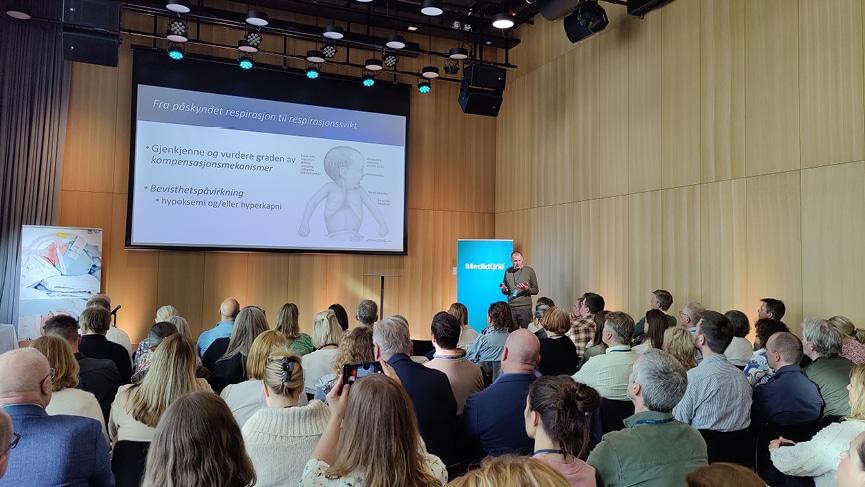
Jo Eidet
O2 = medicine
Next on the agenda was Morten Breindahl, Head Doctor, PhD., Head of the department of neonatal and pediatric intensive care at Copenhagen University Hospital, Rigshospitalet. This was the first of his two talks, and it focused on oxygen as medication.
Morten started out with the key message of his talk: That oxygen should be considered medication, especially in neonatology, and that it should be dosed, monitored, and administered with care. So, Morten shared insights into the effect of oxygen and the consequences of getting too little (hypoxia) or too much (hyperoxia). Both hypoxia and hyperoxia can cause serious harm, ranging from brain and heart injury to conditions like retinopathy of prematurity and bronchopulmonary dysplasia. How do you then balance the dosage? Morten presented four methods: Target-oriented oxygen therapy, use of blender systems, alarm limits and automatic oxygen control, and an individualized strategy. Before opening the debate, Morten concluded that working with oxygen as medication is an interdisciplinary effort that requires transparency, management support, and collaboration.
Dilemmas in respiratory support of children
Morten Breindahl’s second talk addressed the complex and nuanced challenges of providing respiratory support to newborns. About 10% of all newborns need some form of respiratory support. It is life-saving treatment, but respiratory interventions carry risks of complications and long-term harm. This puts further pressure on the decision-making, which often must be quick.
Consider this: For non-invasive respiratory support, how do you handle pressure generation, what interface do you choose, and what ventilator mode? When invasive ventilation is needed, how do you do it in the most lung-protective way possible to prevent VILI, and how do you extubate? Morten gave an overview of a spectrum of non-invasive support modalities – CPAP, BiPAP, NIPPV, HFNC, nHFOV, and NAVA – highlighting their mechanisms, benefits, and limitations. Invasive ventilation was also presented as a necessary but high-risk intervention, requiring lung-protective strategies and early extubation when possible. Morten concluded with perspectives on the future of care: a near future in which new technologies like AI and protocols can support the clinician when facing the wide variety of dilemmas in respiratory support of newborns and children.
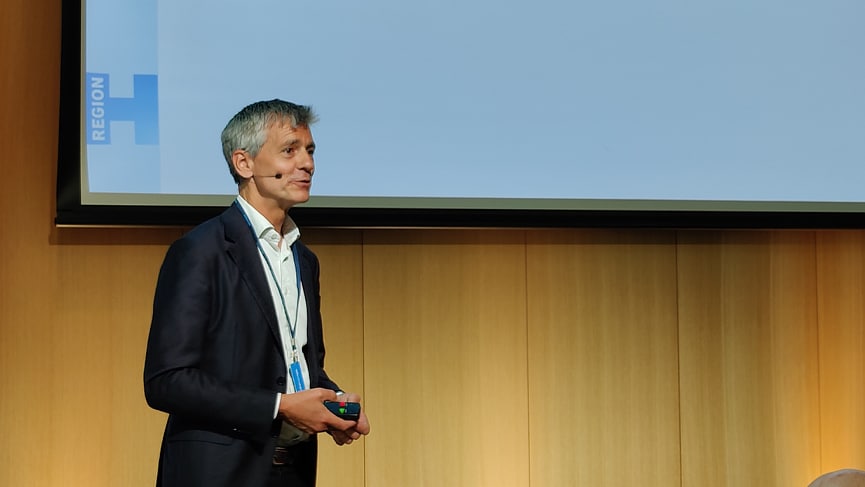
Morten Breindahl
Transport of sick children
Per Bredmose, Consultant in prehospital care and retrieval medicine, Director of Training, and Consultant Anesthetist at Norwegian Air Ambulance, closed the stage on day 1. He talked about transporting sick children in need of respiratory support.
Per did a 360 presentation that covered the work to be done before, during and after transportation. He discussed training for transporting a newborn, and went into the preparation, from both the sending and the receiving department. Here he emphasized the importance of clear communication and close collaboration between teams. Per pointed out that timely communication is key – do not wait until the patient is in bad shape. Per also shed light on the transportation options and what to consider when transporting newborns receiving respiratory support. Ultimately, Per summarized it all in his 10 top tips for successful transport of newborns. Per’s number 1 tip was to know your patient. Though training and simulations are valuable, no two patients are the same.
Is closed loop ventilation a solution for individualized ventilation, and can transpulmonary pressure be a part of this?
First on the stage on day 2 was Øystein Bjelland, Assistant Director of academic and research and Senior Anesthesiologist at the Hospital of Vestfold. Øystein focused on closed loop ventilation and transpulmonary pressure. He showed how the Hamilton Medical feature INTELLiVENT-ASV (avautuu uuteen välilehteen) can help reduce the number of manual interactions with the ventilator and support individualized lung-protective ventilation.
Hamilton’s INTELLiVENT-ASV is an intelligent, automated ventilation mode. It helps clinicians deliver individualized, lung-protective ventilation from intubation to extubation. It dynamically adjusts support in real time based on patient physiology, aiming to reduce staff workload and ventilator adjustments. Øystein explained that its effectiveness depends on sensor accuracy and patient suitability. He shared that a key concept is the expiratory time constant (RCexp), which helps differentiate between normal, restrictive, and obstructive lung conditions.
Øystein also discussed transpulmonary pressure (the difference between alveolar and pleural pressure) as a more accurate measure of lung distending force. Transpulmonary pressure monitoring can help personalize PEEP settings and prevent atelectasis and overdistension. However, Øystein pointed out, it remains technically challenging and not universally applicable.
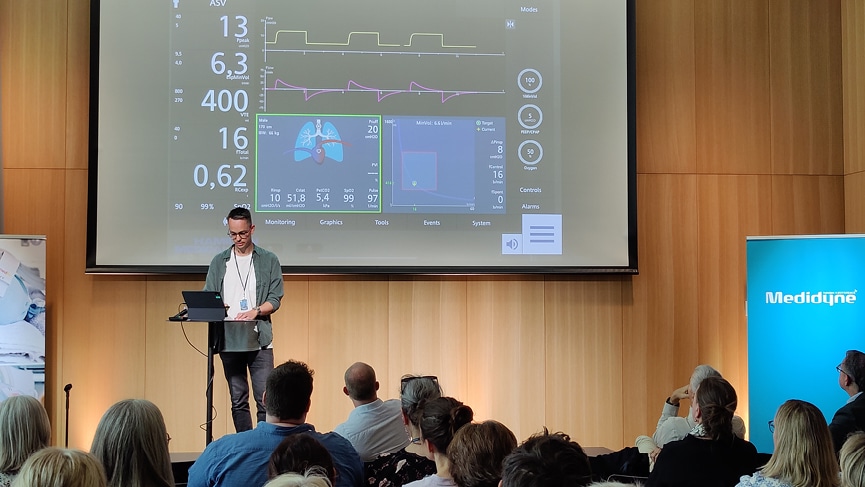
Øystein Bjelland
How to individualize recruitment and PEEP
Stephan Balsliemke, Senior Anesthesiologist and Head of the ICU and anesthesiology department at Vestre Viken Hospital, Drammen, followed Øystein with a talk about recruitment and PEEP in practice, including cases.
In his presentation, Stephan outlined a practical, patient-centered strategy for optimizing mechanical ventilation in ARDS patients. It emphasized the importance of individualizing recruitment maneuvers and PEEP settings to minimize VILI. Key principles included protecting the “baby lung”, reducing mechanical power, and avoiding both atelectrauma and overdistension. Stephan showed how Hamilton’s P/V tool (avautuu uuteen välilehteen) can be used to assess lung-recruitability. After recruitment, he emphasized, PEEP should be titrated – using decremental PEEP trials or esophageal pressure measurements – to maintain lung openness without causing overinflation. In the presentation, Stephan also highlighted the role of intra-abdominal pressure in influencing esophageal pressure readings and stressed the need for more research on mortality outcomes. Ultimately, Stephan advocated for a practical, team-based approach tailored to patient physiology.
Who is in control of the ventilation – the ventilator or the patient?
Alexandra Gerlach, Clinical Specialist at Hamilton Medical, did a talk titled “Who is in control? Patient or ventilator?”. It focused on the critical issue of patient-ventilator synchrony and how to detect asynchronies.
First Alexandra gave an overview of various types of asynchronies, including phase (e.g., delayed triggering, double-triggering, late cycling) and flow asynchronies (e.g., flow overshoot, flow starvation). These mismatches can lead to patient discomfort, increased work of breathing, and potential lung injury. Detection methods range from simple observation and listening to advanced waveform interpretation – the “expert method”.
Then Alexandra introduced IntelliSync+ (avautuu uuteen välilehteen): a Hamilton Medical innovation that mimics expert interpretation. It continuously analyzes waveform patterns to detect patient effort and optimize synchronization in real time. But one must be aware that IntelliSync+ has limitations, such as sensitivity to cardiac oscillations and condensate buildup. The key takeaway from Alexandra’s talk was that effective synchronization improves patient comfort and outcomes, and advanced tools like IntelliSync+ can support clinicians in achieving this.
EIT – a new tool for individualized ventilation?
Fernando Suarez Sipmann, MD. at Hospital Universitario de La Princesa, Madrid was the first of three speakers to talk about electrical impedance tomography (EIT). Fernando had two talks: First, an introduction to EIT and its potential. EIT technology for ventilation monitoring works with a belt around the patient’s chest: It sends a low-intensity current – suitable for all patients from neonatal to adults – and measures resistance. The data is then used to generate images of lung-performance in real time. The key takeaway here was a real teaser for the coming presentations: EIT is a technology that enables non-invasive, real-time monitoring of lung-performance at the bedside.
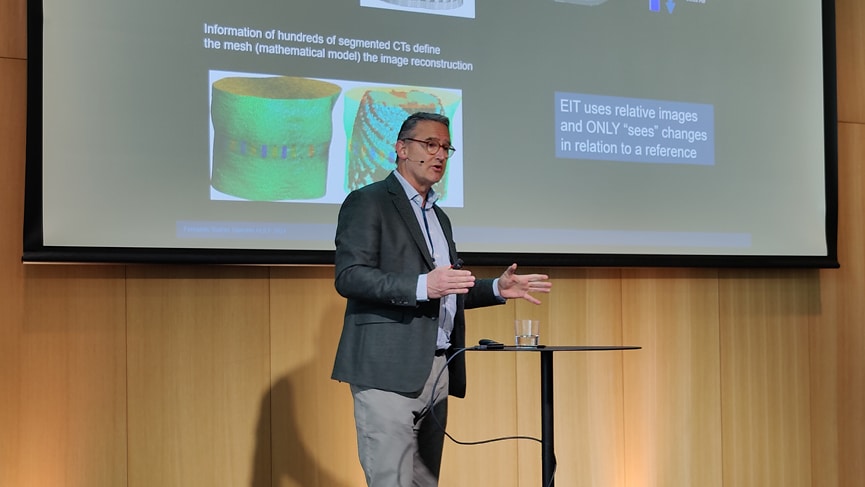
Fernando Suarez Sipmann
V/Q assessment and its clinical applications with Timpel EIT
In his second talk, Fernando delved into V/Q assessment and its clinical applications with Timpel’s EIT monitor, ENLIGHT 2100. Fernando presented how to use EIT to assess ventilation-perfusion (V/Q) matching at the bedside. EIT can detect regional changes in pulmonary perfusion by analyzing vascular pulsatility and the passage of contrast agents like saline or sodium bicarbonate. Therefore, it enables clinicians to visualize perfusion distribution and assess lung-recruitability. This is especially useful in conditions like atelectasis, ARDS, or after interventions such as prone positioning or inhaled nitric oxide (iNO) therapy.
The key message from Fernando was that EIT-derived perfusion maps can help identify mismatched V/Q regions and guide individualized PEEP titration and recruitment strategies. Ultimately, EIT can enhance intervention validation and response monitoring, making it a powerful tool for personalized respiratory care.
Optimizing lung function with individualized positioning strategies guided by Timpel EIT
We had a live connection to Brazil with our speaker Marcelo Amato, MD., PhD., and Professor in medicine at the cardiopulmonary department at University of São Paulo. He shared insights from studies in optimizing lung function with individualized positioning strategies guided by Timpel’s ENLIGHT 2100. Marcelo has done a great deal of research with Timpel’s EIT. He shared a variety of research cases with the audience and showed how the ventilation maps can effectively be used to evaluate and guide positioning. Earlier this year, Timpel also hosted Marcelo for an online session about perfusion. You can watch the session here (avautuu uuteen välilehteen).
Sharing first Nordic experience with Timpel
The last speaker on the stage was Ronni Plovsing, MD., PhD., and Associate Professor at the department of anesthesiology and intensive care at Hvidovre Hospital, University of Copenhagen. Ronni shared the first Nordic experiences with the Timpel ENLIGHT 2100 monitor including cases, questions, and learnings.
Ronni has experience with different EIT technologies and is the first user of Timpel’s EIT monitor in Denmark. He presented early clinical experiences with the system in a Nordic ICU setting. Ronni highlighted key applications such as PEEP titration, ventilation optimization, and trend monitoring. He emphasized the importance of correct belt placement (ideally at ICS 4 or 5) and highlighted challenges like diaphragm interference and mattress artifacts. With cases, Ronni illustrated EIT’s role in managing ARDS, pneumonia, and pulmonary embolism, including supine vs. prone positioning effects. Ronni also noted that standardized protocols are still lacking, but that EIT overall is a valuable tool with growing evidence of clinical benefit. Plus, of course, successful implementation requires dedicated training and awareness of limitations.
Conclusion
Ventilation Symposium 5.0 highlighted how individualized ventilation is no longer a distant goal but an evolving reality. Across pediatric, neonatal, and adult care, the speakers emphasized that personalization can significantly improve outcomes and reduce harm: whether through advanced technologies like INTELLiVENT-ASV and EIT, or through practical strategies for oxygen dosing, PEEP titration, and patient-ventilator synchrony. The discussions underscored the importance of interdisciplinary collaboration, evidence-based decision-making, and continuous innovation to meet the complex challenges of respiratory support. As new tools and protocols emerge, the future of mechanical ventilation increasingly centers on tailoring treatment to each patient’s unique physiology to ensure safer and more effective care.
If you would like to participate at the next Ventilation Symposium, sign up for our newsletter. Then you will receive invitations for events along with product news and insight relevant to your field of work. Do you want more Ventilation Symposium insights? At Ventilation Symposium 3.0 all talks were filmed. Get a recap and access the videos in this article.
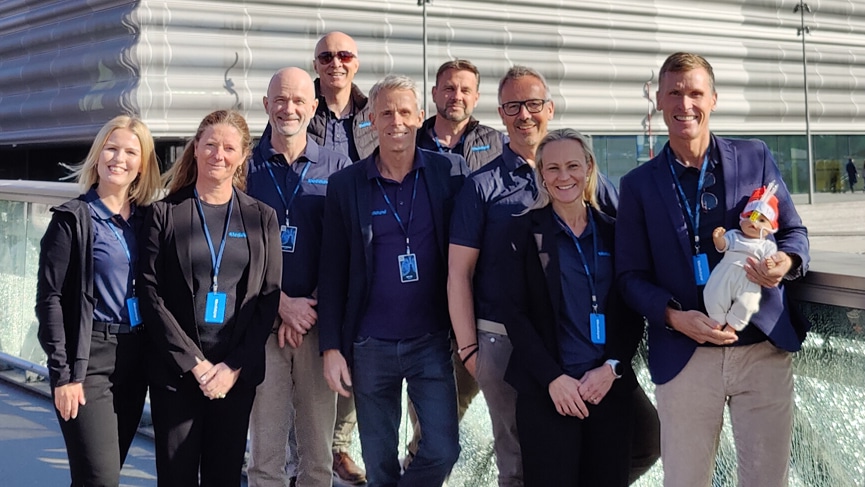
Team Medidyne