Obstructive sleep apnea (avautuu uuteen välilehteen) (OSA) is the most common sleep-related breathing disorder and a serious medical condition that can lead to a variety of health complications. Therefore, getting diagnosed and treated can make a life-changing difference to patients. We have previously written a guide to sleep apnea and diagnosis of the disorder. So, in this article we focus on treatment. We introduce treatment options, devices, and digital tools that set you and your patients up for success. Not least, we have gathered insight on the subject from one of our own sleep apnea experts, Product Specialist Lone Ingemann Sørensen.
Matching therapy option and patient
The three different types of sleep apnea (avautuu uuteen välilehteen) – obstructive sleep apnea (OSA), central sleep apnea (CSA), and mixed sleep apnea – require different treatment. OSA is by far the most common type of sleep apnea and hence, what we will focus on here. Treatment options include continuous positive airway pressure (CPAP) therapy, positional therapy, dental appliances, surgery, and lifestyle changes. Most patients receive CPAP treatment. However, depending on the severity of the disorder and the patient’s sleeping position, positional therapy might be a more optimal solution.
CPAP therapy
CPAP therapy is carried out with a CPAP machine (avautuu uuteen välilehteen). It continuously delivers air through the patient’s nose or mouth to keep airways open during sleep. The machine does so by taking in room air, filtering it, pressurizing it, and then delivering it via a connected tube and mask worn by the patient. Humidification can be added to the air delivered by the device if the patient finds that the air feels dry. Tubes also come in varieties with heat to prevent air from condensing in the tube. Heated humidification (avautuu uuteen välilehteen) can help relieve the feeling of a dry and sore throat and increase comfort.
At Medidyne, we distribute Philips’ DreamStation 2 Advanced across the Nordics. It is an automatic CPAP machine that provides treatment adjusted to the individual patient. This means the device automatically adjusts the pressure within set parameters to suit the needs of the patient and keep treatment comfortable. If needed, the machine can be set at a fixed pressure.
Lone Ingemann Sørensen, Product Specialist at Medidyne, says about CPAP therapy and the DreamStation 2 Advanced: “No two patients are the same. Therefore, the ideal sleep apnea treatment is personalized treatment that adapts to the individual’s needs. It is a treatment that is continuously corrected and optimized so that it considers that sleep apnea changes over time”. She continues: “DreamStation 2 is an example of a CPAP machine that automatically adapts the pressure to the patient’s breathing – or lack thereof. The machine has, among other things, the intelligent Ramp Plus function. It allows patients to adjust the pressure at the start of the treatment to the exact level that is comfortable for them”.
CPAP mask selection
Masks for CPAP therapy come in many different shapes, sizes, and materials to help each patient find a solution that suits their anatomy and preferences. Overall, there are three types of masks: Nasal, pillow, and full face masks. Nasal masks cover the nose. Pillow masks are similar in the way that they also deliver air through the patient’s nose. They differ by using smalls canals – pillows – that is placed in the nostrils. Full face masks cover both nose and mouth.
Nasal masks are typically chosen as the first option when starting CPAP treatment: Studies suggest that they create less leakage (avautuu uuteen välilehteen), require lower pressure (avautuu uuteen välilehteen), and provide better adherence (avautuu uuteen välilehteen). However, a nasal mask is not the right option for everyone, and for some, the full face mask is ideal. This could be patients who have nasal obstruction or frequent congestion, e.g., due to allergies. The full face mask is also suitable for patients who continue to breathe through their mouth at night after trying a nasal mask or pillow mask.
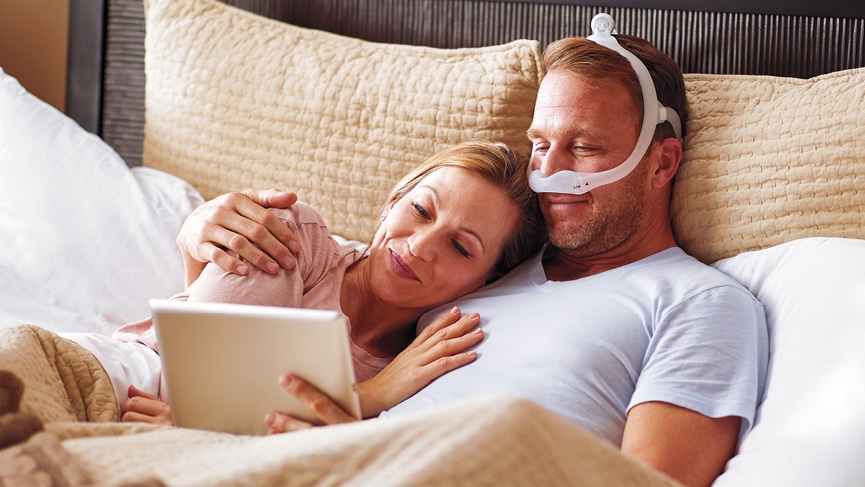
Most masks offer cushions in different sizes to accommodate differences in anatomy. Among the three types of masks there are several styles to choose from. Some have a very minimal design with small cushions and headgear with a few thin straps; creating very little contact between face and mask. Other masks cover a larger area of the face and have headgear with more straps that help keep the mask securely in place. Headgear is typically made of fabric. In addition, fabric sleeves can be added for a softer feel.
The possibilities are many when selecting and adjusting a mask – for a good reason. Lone explains: “Finding the right mask is key to successful treatment. Therefore, most manufacturers offer a broad selection of masks. Even though a nasal mask is advised as the first option, it is not the right solution for all patients. And then it is crucial to try again with something else. Patience is key – both for patients and clinicians. Finding just the right fit and just the right adjustment of the mask is something worth spending time on”.
Medidyne distributes Philips’ masks for sleep therapy. In the portfolio are both nasal, pillow, and full face masks, e.g. the DreamWear series includes a mask in each category.
Positional therapy
While CPAP therapy is effective for treating sleep apnea, it can be challenging for some patients to get used to and adhere to the treatment: Wearing a mask connected to a machine with a tube while sleeping can feel quite invasive and overwhelming. The good news – for some OSA patients – is that they might not need the CPAP machine, if their sleep apnea is positional.
Positional obstructive sleep apnea (POSA) (avautuu uuteen välilehteen) is a form of sleep apnea that mainly occurs when the patient sleeps on the back. Positional therapy therefore aims to prevent the patient from sleeping on the back and consequently reduce or eliminate the apnea episodes. It can be carried out by simply sewing a tennis ball into the back of the sleepwear or sleeping with a specially designed pillow or backpack: solutions that make it too uncomfortable to lie on the back. Another option is a sleep position trainer: a device that vibrates when the patient attempts to sleep on the back. Though the tennis ball method can be effective, a study suggests (avautuu uuteen välilehteen) that a sleep position trainer provides a better sleep quality, quality of life, and compliance.
But before assigning positional therapy, the severity of the OSA needs to be considered. Obstructive sleep apnea can range from mild to severe. This is scored with the apnea-hypopnea index (AHI) (avautuu uuteen välilehteen). It identifies the average number of apnea and hypopnea episodes per hour of sleep. For adults, mild sleep apnea is in the AHI range 5-15. Moderate sleep apnea is between 15 and 30, and an AHI of 30 or higher is categorized as severe sleep apnea. Positional therapy is relevant for patients with mild to moderate POSA (avautuu uuteen välilehteen).
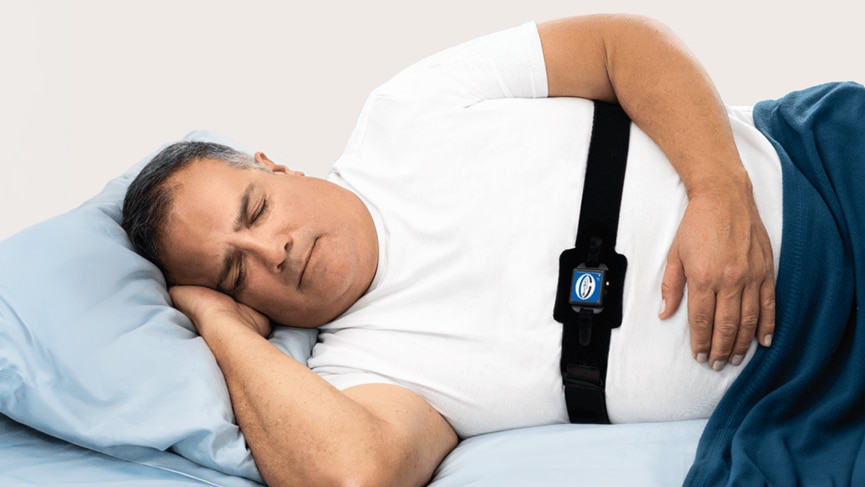
At Medidyne, we distribute Night Shift from Advanced Brain Monitoring: a sleep position trainer that is worn around the neck or chest. It vibrates when the patient attempts to sleep on the back and adjusts treatment to the patient: Vibrations start out gently and increase in intensity until the user changes position. Plus, treatment can be set with a 15- or 30-minute delay, so the patient can fall asleep in any position. Night Shift’s effectiveness is backed by clinical evidence (avautuu uuteen välilehteen): It is accurate and effective in restricting back-sleeping and reducing AHI.
Lone says about Night Shift: “A sleep position trainer is a simple and effective way to treat POSA – for both patients and clinicians. A solution like Night Shift is user-friendly and versatile as it adjusts the vibrations to the patient’s needs. Startup and attachment of the device is easy, and the device can even be reused between patients. The clinician simply resets it on an online platform”.
How digital tools support patient and clinician
Sleep apnea treatment is naturally carried out at home, and it is likely to be lifelong therapy. That means many interactions between patients and clinicians for follow-ups, treatment adjustments, change of equipment, and more. Technological developments allow for some of these activities to be carried out remotely. E.g., telemedicine solutions enable online consultations and remote monitoring of CPAP treatment (avautuu uuteen välilehteen) that are equally as effective as in-person care. A telemedicine consultation is also convenient (avautuu uuteen välilehteen), and more easily accessible for patients who live far away from the clinic or lack transportation options.
The rapid development in wearable technology also means that patients do not necessarily need to talk to a clinician to learn about the progress of their treatment: The devices used at home and apps may present data and insights directly to the patient. This can enhance patient engagement (avautuu uuteen välilehteen) and ultimately contribute to better outcomes. The data collected by wearables and devices in the home is also highly valuable to clinicians, who can continuously monitor and tailor treatment. Plus, telemonitoring of CPAP therapy (avautuu uuteen välilehteen) can save nursing time: something very valuable in busy healthcare environments where staff is lacking and the number of patients is expected to increase. In that way, telemedicine use in CPAP treatment can support scale without sacrificing quality.
Tools for tailored and effective care
Examples from Medidyne’s portfolio include online platforms created to complement the devices for treatment. Philips has created Care Orchestrator and DreamMapper to support OSA treatment. They are compatible with the company’s CPAP machines. Care Orchestrator is an online platform for clinicians. It enables you to collect, store, manage, and view data generated by the patients’ devices. It provides timely, actionable insights, so care can be adjusted to individual needs. Plus, it supports collaboration and efficient workflows in the care team with access to and overview of data.
DreamMapper is a mobile app and website designed to help patients stay motivated and better adhere to their OSA treatment. It provides daily treatment progress, helpful troubleshooting videos, and goal-setting tools. In that way, DreamMapper helps patients take an active role in their sleep apnea treatment.
For patients receiving POSA treatment with Night Shift, Advanced Brain Monitoring has created an app and web solution. The Night Shift sleep position trainer registers position, sleep quality, and snoring. The patient can see the registered data in the Night Shift app or on a PC. In this way, the patient gains insight and can follow the treatment themselves. Clinicians get access to Night Shift data on a web platform. Here you can obtain comprehensive reports that provide in-depth insight into the patient’s sleep quality and behavioral adaptation.
Lone says: “Digital solutions that enable remote monitoring and adjustment can be very valuable in treatment. They allow clinicians to act promptly on changes in patient needs and fine-tune treatment accordingly. Plus, each clinician and care team gets a better overview and more insight with online solutions that gather and present data”. She continues: “For the patients it is also beneficial to get access to their treatment data. Like other health trackers, sleep apnea apps for patients can help boost morale. The patients gain insights that empower them, and that can make them more engaged in their disease management”.
Conclusion
Successful sleep apnea treatment for patients and clinicians is truly two sides of the same coin. When therapy works well, it reflects both effective clinical decision-making and meaningful patient engagement. Modern OSA care is no longer one-size-fits-all; it is personalized, flexible, and increasingly supported by digital tools. For most patients, CPAP remains the cornerstone of treatment, while positional therapy plays an important role for carefully selected individuals. Mask strategies should be pragmatic and patient-centered – starting with a nasal option and adapting as preferences or clinical needs evolve.
Digital platforms add a powerful layer to care by enabling targeted, timely adjustments and continuous monitoring outside the clinic. They help clinicians work more efficiently while empowering patients to take an active role in their own therapy. Ultimately, successful sleep apnea treatment is holistic: It combines the right mask, the right device, the right strategy, and the right digital support into a cohesive solution that improves outcomes for both patients and care teams.